Gaming Stocks Under Fire
Why I think putting the Genie back in the bottle will be tougher for Unity than everyone else.
Video gaming stocks have been getting smoked since Friday after Google (GOOGL) announced the release of their Genie 3 AI world creation tool. While shares of US-based publicly traded video game companies Take-Two (TTWO) and Roblox (RBLX) have each been hit to the tune of 15% or so over the past couple of days (Electronic Arts (EA) is the subject of a buyout and is basically immune to any news and gaming revenues are a rounding error to Activision/Blizzard owner Microsoft (MSFT)), shares of gaming tools creator Unity Software (U) have been hit for over 35%.
This is a free article to all subscribers. If you wish to support the effort of finding novel short ideas to a limited subscriber base before the rest of the street, please consider upgrading to a paid subscription.
Can the street really be getting it right?
Back in September I warned subscribers about the shares of Unity Software (U), explicitly pointing out the dangers AI posed to tool companies like Epic and Unity (I pointed out several other problems with Unity as well).
Since the shares of Unity are now down over 40% since my first mention, I have removed the paywall for any free subscribers who care to read the entire piece. Here’s the link.

Unity’s Quandary
About a third of Unity’s revenues are related to their tools business (referred to as “Create” revenues in their filings) while the rest are related to ad monetization inside the games their tools help create (these are “Grow” revenues).
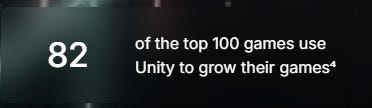
As mentioned in my piece, Unity already counts the developers of 82 of the top 100 mobile games as subscribers to their tools, which makes further penetration into this market increasingly difficult. There will likely always be at least a handful of top 100 games that are made by small, independent developers that may never be a potential customer for their tools.
So what do you do when your market is pretty saturated and yet shareholders are still expecting you to show revenue growth?
Well, that’s where price hikes come into play, which is something Unity began instituting last year, and that was responsible for the majority of the company’s revenue growth over the past several quarters.
Which places Unity into something of a quandary, right? They just institute a price hike and place all of their customers into a subscription model, and now GOOGL comes along with Genie AI tools that may help developers bypass much of Unity’s offerings altogether.
What do companies typically do in situations like this when they’re trying to maintain their market share? Drop prices.
Has that happened yet? I don’t believe so.
Will it happen? We may soon find out. Earnings are due February 11th.
Final Thoughts
First off, software stocks in general have been incredibly weak this earnings season, so perhaps some of that weakness is simply filtering down into the gaming sector. MSFT disappointed, SAP got smacked, and each day we seem to be getting news of another disappointment. The iShares Software ETF (IGV) is down over 17% in the last month alone and it tracks the biggest US-based software companies. For every PLTR which hits it out of the park, there’s a NOW and CRM that does not.
My overall feeling is that AI tools, whether it’s Genie or something else that’s on the horizon (I mentioned in my piece that xAI tools have been developing some amazing looking worlds too), will undoubtedly be impacting video game design, most likely on the edge at first, and then into more mainstream games.
Much like Hollywood blockbusters, I think the big-ticket video games (Call of Duty, Grand Theft Auto, World of Warcraft) are unlikely to face significant pressure in the near or even the medium term. These projects each involve hundreds of creators that have budgets in the hundreds of millions of dollars, and a small indie outfit cobbling together their next project with help from AI will unlikely be able to match those resources or efforts for quite a long time.
On the edge, however, it may be a different story. Unity’s tools are primarily used for the creation of mobile games, which have budgets that are a fraction of those committed to either PC or platform games. Here I can easily see the bottom tier of their developer base defecting, which would not only take away from their “Create” revenues, but also fewer games developed using their tools would impact their ad-based “Grow” revenues as well (which may be why APP is getting smacked as well).
While I no longer have access to street research, I have been reading various analyst excerpts, and for the most part, think that the street, while perhaps a bit late to the game, may be getting this one right.